How to Track Calories Without Weighing Food
No food scale? No problem. You can log calories accurately using hand portions, common measures, labels, and AI scanning — here's exactly how, and how accurate it really is.
Why You Don't Always Need a Scale
Food scales are the most precise way to track, but they're not the only way — and for a lot of people, the friction of weighing every meal is exactly what makes them quit. The goal of tracking isn't perfection; it's a consistent, roughly-accurate signal you can act on. If your estimates are reasonable and consistent, your weight trend will still tell you whether to eat more or less.
There are really only two situations: packaged food (where the exact numbers are printed for you) and unpackaged whole food (where you estimate). The methods below handle both.
The Hand Portion Method
Your hand is a measuring tool you always have with you, and it scales with your body size. This is the backbone of scale-free tracking:
| Hand cue | Food type | Approx. portion |
|---|---|---|
| Palm | Protein (meat, fish, tofu) | ~100–120g / ~25–30g protein |
| Cupped hand | Carbs (rice, pasta, oats) | ~1/2 cup cooked / ~25g carbs |
| Fist | Vegetables | ~1 cup |
| Thumb | Fats (oil, butter, nut butter) | ~1 tbsp / ~10g fat |
Most plates are a few palms, fists, and thumbs combined. Once you've weighed a few foods early on to calibrate your eye, hand portions become second nature.
Common Household Measures
For anything you serve with cups, spoons, or pieces, skip the scale entirely and log by the measure:
- Measuring cups/spoons — perfect for rice, oats, yoghurt, oils, sauces
- Pieces and slices — "2 slices of bread", "1 medium banana", "1 egg" are all standard database entries
- Containers — a standard mug ≈ 250ml, a tablespoon ≈ 15ml; use what you have
Good tracking apps store calories per cup, per slice, and per piece — not just per gram — so you log "1 cup cooked rice" without converting anything.
Packaged Foods: Just Use the Label
This is the part people overcomplicate. Anything with a barcode has exact nutrition printed on it. Scan the barcode (or read the label) and log by servings or by the portion size stated. No estimation, no scale — the manufacturer already did the math. For a big chunk of most people's diets, tracking is therefore already scale-free and exact.
AI Photo Scanning for Mixed Meals
For restaurant plates, home-cooked dishes, and anything hard to break down, an AI food scanner does the estimating for you: photograph the meal and it identifies the foods and estimates portions and calories. It's not perfect — a photo can't see hidden oil — but it's fast and good enough for a quick log, especially when you confirm or nudge the portion it suggests.
How Accurate Is It?
Estimating whole-food portions by hand or eye is typically within 10–20% of weighed values. That sounds loose, but two things make it work:
- Packaged foods are exact, so the estimation only applies to part of your intake.
- Consistency beats precision. If you estimate the same way every day, your weight trend still moves predictably — and you adjust calories based on that trend, not on a single perfect number.
If you're a competitive athlete, in a cut's final weeks, or troubleshooting a stubborn plateau, weighing high-calorie foods (oils, nut butters, cheese, granola) for a week sharpens accuracy where it matters most. For everyone else, estimates are fine.
The Easiest Way to Do This
NutriBalance
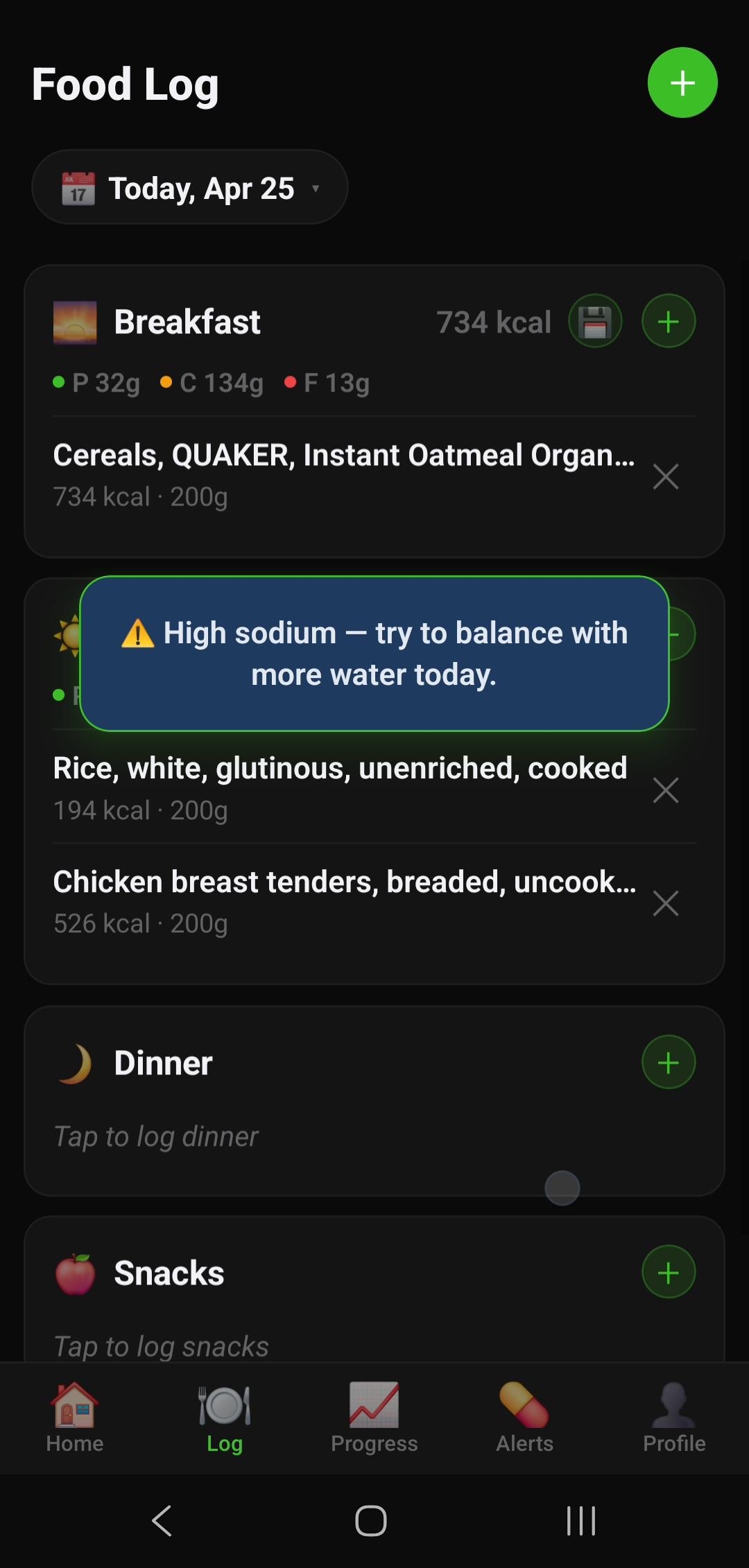
NutriBalance is designed so you never have to weigh anything. Its AI food scanner estimates portions from a photo, the 7M+ barcode database logs packaged foods exactly, and every food entry includes household measures — cups, tablespoons, slices, pieces — alongside grams. Add full macro tracking and a streak system that keeps you logging, and scale-free tracking becomes genuinely effortless.
The Bottom Line
You don't need a food scale to track calories. Estimate whole foods with hand portions and common measures, log packaged foods exactly from the barcode, and let an AI scanner handle mixed meals. Stay consistent and your results won't know the difference.
Try NutriBalance free for 14 days — Android Try NutriBalance free for 14 days — iOS